Understanding the PWS Spot Shrimp Fishery
Spot Shrimp Life Cycle
Spot shrimp (Pandalus platyceros) have a unique biological trait called protandric hermaphroditism—every individual begins life as a male and transitions to female in midlife. This has profound implications for population dynamics and fishery management.
Key Biological Facts
- In PWS, spot shrimp live 7-10 years (per ADFG tagging studies)
- Shrimp reach marketable size (≥32mm) at approximately 3-4 years
- Average age of male-to-female transition: 5-6 years
- Each female produces only one clutch per year
- Spot shrimp are sedentary—they do not migrate
Reproductive Cycle
| Month | Stage | % Egg-Bearing |
|---|---|---|
| Aug-Sep | Mating season | - |
| October | Egg development | 94% |
| April | Eggs hatching | 36% |
| May | Post-hatch | 5% |
ShrimpPros Association proposed and achieved the May 1 regulatory season start at the 2025 Board of Fisheries, moving the opener from April 15. This science-based conservation measure ensures most egg-bearing females have completed their spring larval release before harvest begins.
With 94% of females egg-bearing in October, 36% still carrying in April, and only 5% by May, the delayed start allows harvested females to contribute their annual reproductive output—a critical protection for a stock in decline.
Management Structure
PWS shrimp fisheries are managed through a collaborative framework involving multiple state agencies and public input processes.
ADFG
Alaska Department of Fish & Game
- Sets TAH based on stock surveys
- Issues emergency orders
- Conducts annual surveys
- Manages in-season closures
- Develops management plans
CFEC
Commercial Fisheries Entry Commission
- Issues commercial permits
- Reviews limited entry petitions
- Maintains permit holder records
- Sets permit eligibility
BOF
Board of Fisheries
- Sets fishing regulations
- Allocates between user groups
- Reviews proposals (3-year cycle)
- Takes public testimony
PWS Shrimp Regulations by Sector
Direct links to current regulations and fishery information
| Sector | Regulations | Fishery Info |
|---|---|---|
| Sport | 5 AAC 55 (Sport Shrimp) | PWS Sport Shrimp Info |
| Subsistence | 5 AAC 01 (Subsistence) | PWS Subsistence Info |
| Commercial | 5 AAC 31 (Commercial Shrimp) | PWS Commercial Shellfish |
| User Group | Residency | License Required | Federal Matching Funds |
|---|---|---|---|
| Subsistence | Alaska residents only | No (free permit only) | No |
| Commercial | Any (97% AK residents) | CFEC permit + crew license | No |
| Sport | Any (~12% non-residents) | Sport fishing license | Yes (Dingell-Johnson) |
Funding implication: Sport fishing licenses generate federal Sport Fish Restoration (Dingell-Johnson) matching funds—Alaska receives ~$3 for every $1 in license fees. Subsistence users, requiring only a free permit, generate no federal matching funds. This creates a structural incentive to prioritize sport fisheries over subsistence use in management decisions.
2026 access paradox: The commercial fishery (serving 97% Alaska resident fishers who supply local markets) is closed. Meanwhile, non-resident sport anglers (~12% of sport permits)—with no bag or possession limits—retain full access to the resource.
Alaska's Constitutional Access Priority
When resources are limited, Alaska law establishes a clear priority
| Priority | User Group | Legal Basis | Residency |
|---|---|---|---|
| 1st (Highest) | Subsistence | AS 16.05.258 | Alaska residents only |
| 2nd | Commercial | Article VIII §15, AS 16.43 | 97% Alaska residents |
| 3rd (Lowest) | Sport | General recreational access | ~12% non-residents |
What the law requires: Subsistence priority when resources are limited (AS 16.05.258). Commercial access protected for Alaska fishermen (Article VIII §15).
What's happening: Commercial (97% AK residents) is CLOSED. Sport (~12% non-residents) is OPEN with no possession limits.
The result: Non-resident sport anglers continue harvesting while Alaska commercial fishermen—who supply local markets, farmers markets, and direct sales—are shut out. Subsistence users share a reduced resource with non-residents who have no possession limits.
Area Rotation System
The PWS commercial shrimp pot fishery operates under a triennial area rotation system (5 AAC 31.210), where each of three management areas is commercially fished once every three years.
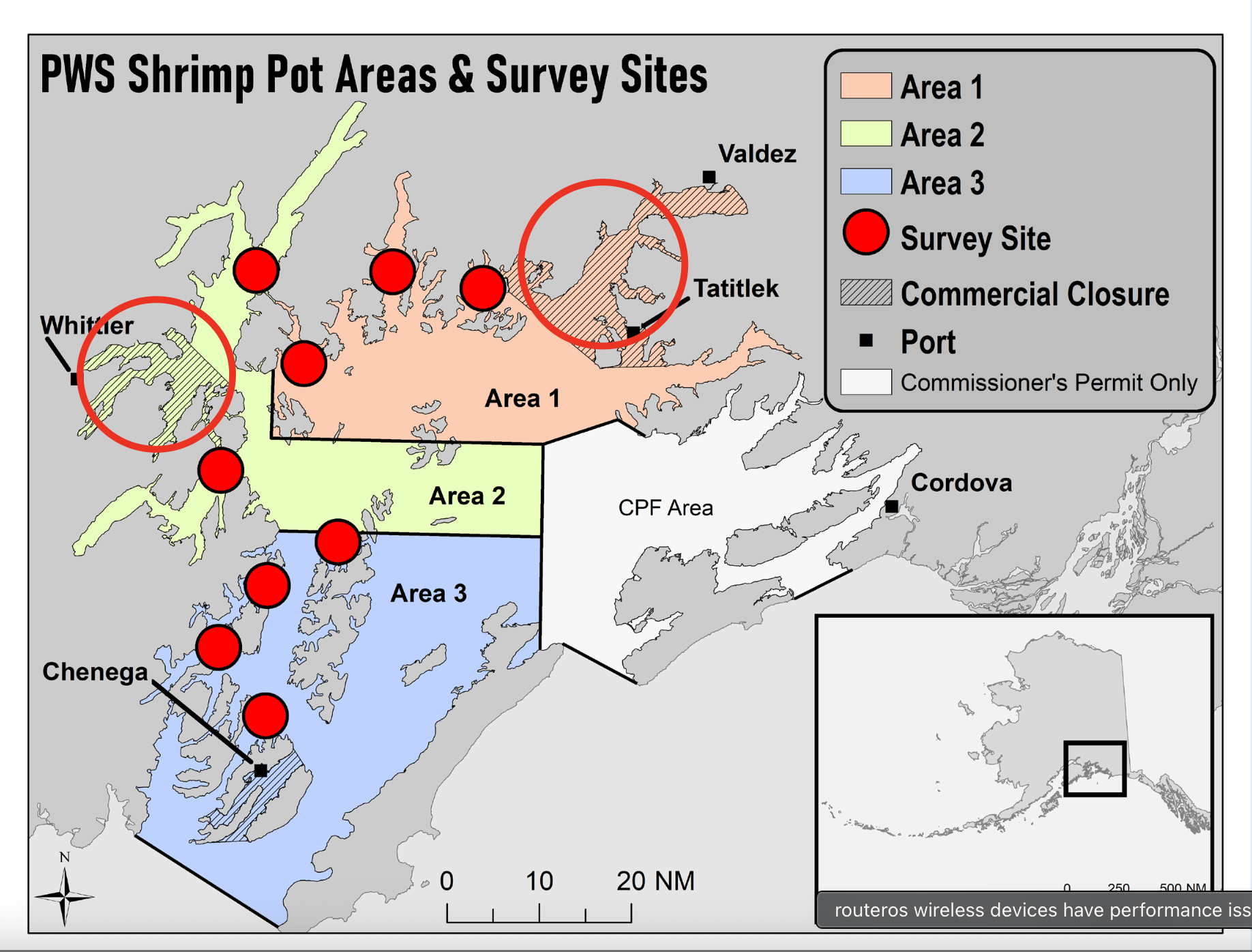
Source: ADFG. Red circles indicate annual survey sites used to calculate CPUE.
| Year | Commercial Area | Areas Closed to Commercial |
|---|---|---|
| 2022 | Area 1 (Northern PWS) | Areas 2, 3 |
| 2023 | Area 2 (Central PWS) | Areas 1, 3 |
| 2024 | Area 3 (Southern PWS) | Areas 1, 2 |
| 2025 | Area 1 (Northern PWS) | Areas 2, 3 |
| 2026 | SUSPENDED - Area 2 rotation deferred to 2027 if TAH supports commercial fishery | |
The 3-year rotation provides only 2 years of rest between commercial harvest. However, spot shrimp require 5+ years to reach female breeding maturity. This means a shrimp may be harvested twice before ever reproducing as a female.
Key issue: While commercial fishing rotates, noncommercial fishing occurs in ALL areas every year—eliminating any true "rest period."
Why Limited Entry Matters
The PWS shrimp pot fishery is currently an open access commercial fishery, meaning anyone with a valid permit can participate. This creates economic instability and management challenges.
The 2010 Reopening
After the fishery was closed from 1992-2009, the 2010 reopening saw 102 vessels register. This immediate dilution of opportunity reduced per permit average earnings even when stock was healthy.
Open Access Effects
- Economic instability: Per permit average earnings fluctuate wildly based on participation
- No fleet stability: New entrants every year, experienced fishers leave
- Crossover fishing: Sport fishers use commercial permits, diverting value
- No investment incentive: Uncertain future prevents fleet modernization
Article VIII, Section 15 of the Alaska Constitution authorizes the legislature to "limit entry into any fishery for purposes of resource conservation, to prevent economic distress among fishermen and those dependent upon them for a livelihood and to promote the efficient development of aquaculture in the state."
This 1972 amendment passed with 78.73% voter approval, establishing overwhelming public mandate for protecting Alaska's professional fisheries from economic destruction.
Fleet Residency: By Alaskans, For Alaskans
The PWS commercial shrimp pot fishery is overwhelmingly comprised of Alaska residents who provide local Alaskans access to fresh, wild-caught PWS spot shrimp. These fishermen supply farmers markets, local restaurants, and direct-to-consumer sales throughout Alaska—ensuring this prized resource remains available to Alaskan communities.
Source: CFEC permit records analysis (2010-2025). Of 582 unique permit holders, 542 are Alaska residents. In recent years (2022-2025), 261 of 269 active fishermen (97%) are Alaskans.
Constitutional & Statutory Framework
Alaska's constitution and statutes establish clear priorities for fishery management that protect resident access and economic viability.
Alaska Constitution Article VIII - Natural Resources
| Section | Provision | Application to PWS Shrimp |
|---|---|---|
| Section 4 Sustained Yield |
"Fish... shall be utilized, developed, and maintained on the sustained yield principle." | Non-commercial harvest exceeded GHL in 8 of 16 years—violating the constitutional mandate. Commercial stayed within 3% of allocation. |
| Section 15 Limited Entry |
"...does not restrict the power of the State to limit entry into any fishery for purposes of resource conservation, to prevent economic distress among fishermen..." | At $5,632/permit (2025), economic distress exists. The constitution explicitly authorizes limitation to address this. |
Alaska Statutes - Fishery Management
| Statute | Requirement | Current Status |
|---|---|---|
| AS 16.43.010 Limited Entry Act |
"To promote... the economic health and stability of commercial fishing in Alaska" | Two co-equal mandates: conservation AND economic health. Both are threatened. |
| AS 16.05.258 Subsistence Priority |
When harvestable surplus is insufficient, subsistence uses have priority over other consumptive uses. | Subsistence (AK residents) should have priority over sport (open to non-residents) when resources are limited. |
| ADFG Mission (AS 16.05) |
"Manage... in the best interest of the economy and well-being of the people of the state, consistent with the sustained yield principle." | Commercial fishery serves 99% of Alaskans who consume shrimp but don't fish. Non-commercial serves only ~2,300 active participants. |
Current management inverts the constitutional and statutory priorities:
- Commercial fishery (97% AK residents, serving statewide consumers): CLOSED
- Sport fishery (open to non-residents, no bag limits): OPEN
- Subsistence (AK residents only, statutory priority): OPEN, but generates no federal funding for management
Constitutional conflict: Article VIII requires management for "the economy and well-being of the people of the state." Closing the resident-operated commercial fishery while allowing unlimited non-resident sport access contradicts this mandate.
Statutory conflict: AS 16.05.258 establishes subsistence priority over other uses when resources are limited. Yet sport fishing (open to non-residents) continues with no bag or possession limits while subsistence users (AK residents only) share the same restricted resource.
When Governor Egan transmitted the Limited Entry Act to the Legislature on January 10, 1973, he specifically addressed shrimp fisheries:
"It is acknowledged that other important Alaska fisheries, such as king crab and shrimp, are already suffering from too much fishing effort and may require their own limited entry programs in the near future."
Governor Egan also warned that without limitation, fisheries would be "taken over increasingly by moonlighters, sport-commercial, and part-time hobby fishermen" who "can afford to participate in the fishery even when it is not profitable"—exactly describing the crossover problem now present in PWS shrimp.
Data Sources & Documents
Primary Source Documents
Key documents referenced throughout this site
| Document | Description | Link |
|---|---|---|
| Governor Egan's 1973 Letter | Transmittal of Limited Entry Act to Legislature; explicitly mentions shrimp fisheries needing limitation | PDF (1.1 MB) |
| ADFG SP 25-07 | Prince William Sound Shrimp Pot Fisheries through 2023; complete fishery history and regulations | PDF (3.5 MB) |
| RC3 Tab 6 (2025 BOF) | ADFG presentation on PWS shrimp management; includes surplus production model, stock status, life history | PDF (10 MB) |
| Alaska Constitution Art. VIII | Natural Resources article; Sections 4 (Sustained Yield) and 15 (Limited Entry) | Ballotpedia |
| AS 16.43 (Limited Entry Act) | Alaska Statutes governing commercial fisheries entry limitation | AK Legislature |
| AS 16.05.258 (Subsistence) | Establishes subsistence priority for Alaska residents when resources are limited | AK Legislature |
External Data Sources
- Stock surveys: ADFG PWS Spot Shrimp Survey Reports (2010-2025)
- Management decisions: Alaska Board of Fisheries meeting records
- Permit data: CFEC permit records and participation reports
- Enforcement data: Alaska DPS Public Information Requests PIR-2025-4920, PIR-2026-381
- Regulations: 5 AAC 31 (Commercial Shrimp), 5 AAC 55 (Sport Shrimp)